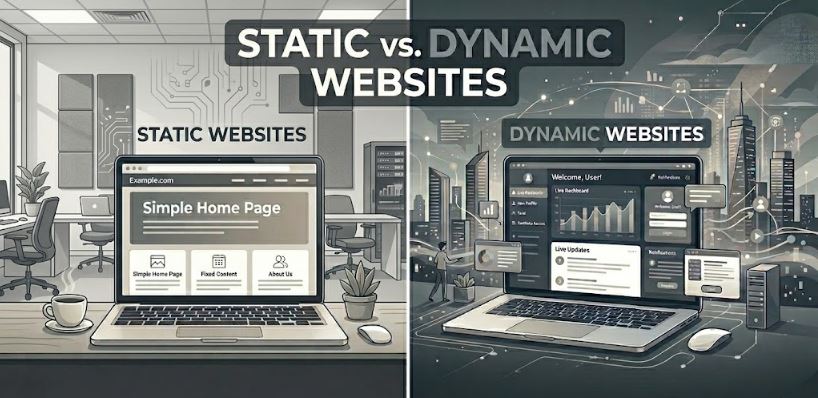
In modern web development, understanding the difference between static websites and dynamic websites is essential for businesses, developers, and digital marketers. A website’s architecture affects page speed, user experience, search engine indexing, security, and scalability.
Search engines like Google and Bing analyze how websites deliver content to users. Factors such as HTML structure, server response time, database queries, and JavaScript rendering influence how easily search engines crawl and rank web pages.
This guide explains the key differences between static and dynamic websites, including how they work, the technologies behind them, and when each type is the best choice.
What Is a Static Website
A static website consists of web pages with fixed content that is delivered exactly as stored on the server. Each page is built using HTML (HyperText Markup Language) and styled with CSS (Cascading Style Sheets).
When a user visits a static page, the web server sends the pre-built HTML file directly to the browser. Since there is no database or server-side processing involved, the page loads quickly and consistently.
Key Characteristics of Static Websites
- Built mainly with HTML, CSS, and lightweight JavaScript
- Pages are pre-rendered and stored on the server
- Content remains the same for every visitor
- Updates require manual editing of the source code
- Often hosted using Content Delivery Networks (CDNs)
Platforms such as GitHub Pages, Netlify, and Amazon S3 are commonly used to host static websites.
Advantages of Static Websites
1. Faster Website Performance
Static websites typically load faster because the browser receives a ready-to-display HTML file. There are no database calls or server-side processing delays.
2. Strong Security
Static websites have fewer vulnerabilities since they do not rely on server-side scripts or database connections. This reduces the risk of SQL injection attacks and malware exploitation.
3. Lower Hosting Costs
Because static sites require fewer server resources, they can be hosted at a lower cost using CDN-based hosting platforms.
4. Better Stability
With fewer moving parts in the system, static websites experience fewer technical failures or compatibility issues.
Limitations of Static Websites
- Updating content requires manual changes in the code
- Difficult to manage large numbers of pages
- Limited interactivity and user personalization
- No built-in database functionality
Common Use Cases for Static Websites
Static websites are ideal for:
- Portfolio websites
- Small business websites
- Product landing pages
- Personal blogs with minimal updates
- Documentation or informational sites
What Is a Dynamic Website
A dynamic website generates content in real time using server-side programming and databases. Unlike static websites, dynamic pages change depending on user interaction, stored data, or application logic.
Dynamic websites rely on technologies such as:
- PHP
- Python
- Node.js
- Ruby on Rails
- MySQL or PostgreSQL databases
- Content Management Systems (CMS) like WordPress, Drupal, and Joomla
When a user opens a page on a dynamic website, the server processes the request, retrieves relevant data from a database, and builds the page before sending it to the browser.
Key Characteristics of Dynamic Websites
- Content is generated in real time
- Data is stored and retrieved from a database
- Website owners can update content using a CMS dashboard
- Pages can display personalized information
Dynamic websites power most modern online platforms.
Advantages of Dynamic Websites
1. Easy Content Management
With a CMS like WordPress, website owners can update pages, publish blog posts, and manage media without editing code.
2. Personalized User Experience
Dynamic websites can display customized content based on user location, preferences, or account data.
3. Scalability for Large Websites
Large websites with thousands of pages benefit from storing content in databases rather than creating individual HTML files.
4. Advanced Features
Dynamic websites support many advanced functionalities such as:
- User accounts and login systems
- Online shopping carts
- Search functionality
- Comment sections
- Interactive dashboards
Limitations of Dynamic Websites
- Slower performance if poorly optimized
- Requires stronger hosting infrastructure
- More complex development and maintenance
- Higher security risks if software updates are ignored
Key Differences Between Static and Dynamic Websites
| Feature | Static Website | Dynamic Website |
| Content Delivery | Pre-built HTML pages | Generated in real time |
| Technologies | HTML, CSS, JavaScript | PHP, Python, Node.js, Databases |
| Speed | Very fast loading | Depends on server and database |
| Updates | Manual coding required | Managed through CMS |
| Interactivity | Limited | Highly interactive |
| Security | More secure due to simplicity | Requires regular updates and monitoring |
| Scalability | Best for smaller sites | Ideal for large platforms |
When to Choose a Static Website
A static website is the best option when:
- The site has fewer pages
- Content does not change frequently
- High performance and security are top priorities
- The website mainly provides informational content
Static sites are often used for marketing landing pages, startup websites, and personal portfolios.
When to Choose a Dynamic Website
A dynamic website is more suitable if your project requires:
- Frequent content updates
- Blog publishing capabilities
- User login systems
- E-commerce functionality
- Interactive features or applications
Businesses running online stores, membership platforms, or content-heavy blogs typically use dynamic websites.
FAQs
What is the main difference between a static and a dynamic website?
A static website shows fixed content using HTML pages, while a dynamic website generates content in real time using databases and server-side programming.
Are static websites faster than dynamic websites?
Yes. Static websites usually load faster because pages are pre-built and delivered directly from the server or CDN without database processing.
Which website type is better for SEO?
Both can rank well. Static websites offer faster speed, while dynamic websites are better for publishing large amounts of SEO content like blogs and landing pages.
When should you use a dynamic website?
Use a dynamic website when you need features like blogs, e-commerce, user accounts, content updates, or interactive functionality.
Conclusion
The main difference between static and dynamic websites is how pages are created and delivered. Static websites are fast, simple, and secure, while dynamic websites provide flexibility, database integration, and advanced features.
The right choice depends on your business goals and content needs. Small informational sites often work best with static architecture, while blogs, business platforms, and eCommerce stores usually require dynamic systems for scalability and content management.
Planning to build a website for your business? Digious Solutions is a trusted web development company serving clients in the USA and Australia.
Contact us today for a free consultation and discuss your project with our experts.